
-->
- Azure Storage Explorer Download Microsoft
- Microsoft Blob Storage Explorer
- Microsoft Blob Storage Pricing
- Azure Blob Storage Explorer
This article shows you how to use Azure Storage Explorer to manage access control lists (ACLs) in storage accounts that has hierarchical namespace (HNS) enabled.
You can use Storage Explorer to view, and then update the ACLs of directories and files. ACL inheritance is already available for new child items that are created under a parent directory. But you can also apply ACL settings recursively on the existing child items of a parent directory without having to make these changes individually for each child item.
Easily manage the contents of your storage account with Azure Storage Explorer. Upload, download, and manage blobs, files, queues, tables, and Cosmos DB entities. Gain easy access to manage your virtual machine disks. Work with either Azure Resource Manager or classic storage accounts, plus manage and configure cross-origin resource sharing (CORS) rules. microsoft/AzureStorageExplorer. Storage Made Easy Cloud File Explorer is the Windows 8 client for the Storage Made Easy Open Cloud Platform. It enables users to view and manage files from many different clouds directly from your Windows Device. The App works with SME free, personal, IaaS, and with the on-premise EFSS Enterprise solution.
This article shows you how to modify the ACL of file or directory and how to apply ACL settings recursively to child directories.
Prerequisites
An Azure subscription. See Get Azure free trial.
A storage account that has hierarchical namespace (HNS) enabled. Follow these instructions to create one.
Azure Storage Explorer installed on your local computer. To install Azure Storage Explorer for Windows, Macintosh, or Linux, see Azure Storage Explorer.
Note Pain exist v3.4elite exploiters.
Storage Explorer makes use of both the Blob (blob) & Data Lake Storage Gen2 (dfs) endpoints when working with Azure Data Lake Storage Gen2. If access to Azure Data Lake Storage Gen2 is configured using private endpoints, ensure that two private endpoints are created for the storage account: one with the target sub-resource blob and the other with the target sub-resource dfs.
Sign in to Storage Explorer
When you first start Storage Explorer, the Microsoft Azure Storage Explorer - Connect window appears. While Storage Explorer provides several ways to connect to storage accounts, only one way is currently supported for managing ACLs.
| Task | Purpose |
|---|---|
| Add an Azure Account | Redirects you to your organization's sign-in page to authenticate you to Azure. Currently this is the only supported authentication method if you want to manage and set ACLs. |
| Use a connection string or shared access signature URI | Can be used to directly access a container or storage account with a SAS token or a shared connection string. |
| Use a storage account name and key | Use the storage account name and key of your storage account to connect to Azure storage. |
Select Add an Azure Account and click Sign in.. Follow the on-screen prompts to sign into your Azure account.
When it completes connecting, Azure Storage Explorer loads with the Explorer tab shown. This view gives you insight to all of your Azure storage accounts as well as local storage configured through the Azurite storage emulator, Cosmos DB accounts, or Azure Stack environments.
Manage an ACL
Right-click the container, a directory, or a file, and then click Manage Access Control Lists. The following screenshot shows the menu as it appears when you right-click a directory.
The Manage Access dialog box allows you to manage permissions for owner and the owners group. It also allows you to add new users and groups to the access control list for whom you can then manage permissions.
To add a new user or group to the access control list, select the Add button. Then, enter the corresponding Azure Active Directory (Azure AD) entry you wish to add to the list and then select Add. The user or group will now appear in the Users and groups: field, allowing you to begin managing their permissions.
Note
It is a best practice, and recommended, to create a security group in Azure AD and maintain permissions on the group rather than individual users. For details on this recommendation, as well as other best practices, see Access control model in Azure Data Lake Storage Gen2.
Use the check box controls to set access and default ACLs. To learn more about the difference between these types of ACLs, see Types of ACLs.
Apply ACLs recursively
You can apply ACL entries recursively on the existing child items of a parent directory without having to make these changes individually for each child item.
To apply ACL entries recursively, Right-click the container or a directory, and then click Propagate Access Control Lists. The following screenshot shows the menu as it appears when you right-click a directory.
Next steps

Learn about the Data Lake Storage Gen2 permission model. Worlds easiest game.
-->In this quickstart, you learn how to use Azure Storage Explorer to create a container and a blob. Next, you learn how to download the blob to your local computer, and how to view all of the blobs in a container. You also learn how to create a snapshot of a blob, manage container access policies, and create a shared access signature.
Prerequisites
Azure Storage Explorer Download Microsoft
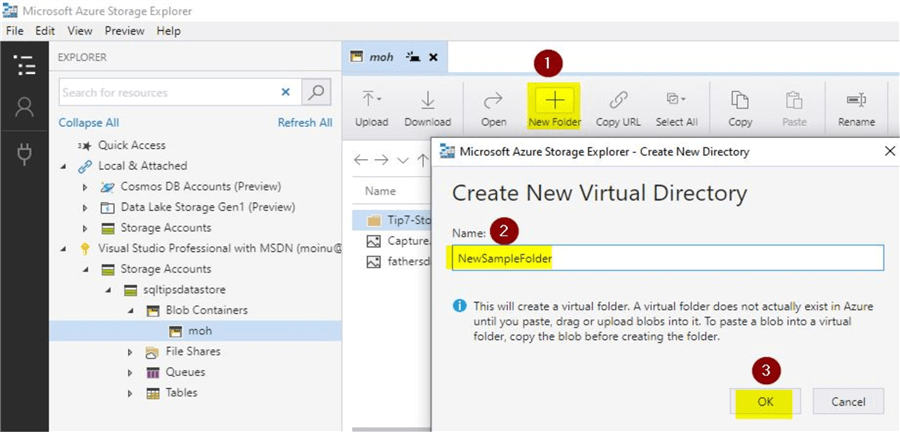
To access Azure Storage, you'll need an Azure subscription. If you don't already have a subscription, create a free account before you begin.
All access to Azure Storage takes place through a storage account. For this quickstart, create a storage account using the Azure portal, Azure PowerShell, or Azure CLI. For help creating a storage account, see Create a storage account.
This quickstart requires that you install Azure Storage Explorer. To install Azure Storage Explorer for Windows, Macintosh, or Linux, see Azure Storage Explorer.
Log in to Storage Explorer
On first launch, the Microsoft Azure Storage Explorer - Connect window is shown. Storage Explorer provides several ways to connect to storage accounts. The following table lists the different ways you can connect:
| Task | Purpose |
|---|---|
| Add an Azure Account | Redirects you to your organization's sign-in page to authenticate you to Azure. |
| Use a connection string or shared access signature URI | Can be used to directly access a container or storage account with a SAS token or a shared connection string. |
| Use a storage account name and key | Use the storage account name and key of your storage account to connect to Azure storage. |
Select Add an Azure Account and click Sign in.. Follow the on-screen prompts to sign into your Azure account.
When it completes connecting, Azure Storage Explorer loads with the Explorer tab shown. This view gives you insight to all of your Azure storage accounts as well as local storage configured through the Azurite storage emulator, Cosmos DB accounts, or Azure Stack environments.
Create a container
Blobs are always uploaded into a container. This allows you to organize groups of blobs like you organize your files on your computer in folders.
To create a container, expand the storage account you created in the proceeding step. Select Blob Containers, right-click and select Create Blob Container. Enter the name for your blob container. See the Create a container section for a list of rules and restrictions on naming blob containers. When complete, press Enter to create the blob container. Once the blob container has been successfully created, it is displayed under the Blob Containers folder for the selected storage account.
Upload blobs to the container
Blob storage supports block blobs, append blobs, and page blobs. VHD files used to back IaaS VMs are page blobs. Append blobs are used for logging, such as when you want to write to a file and then keep adding more information. Most files stored in Blob storage are block blobs.
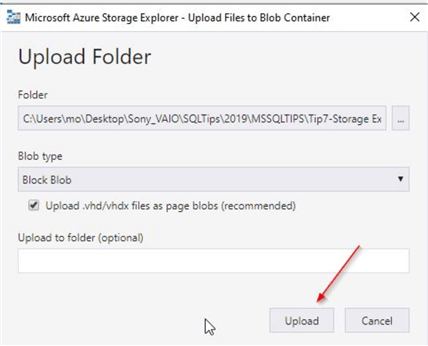
On the container ribbon, select Upload. This operation gives you the option to upload a folder or a file.
Choose the files or folder to upload. Select the blob type. Acceptable choices are Append, Page, or Block blob.
If uploading a .vhd or .vhdx file, choose Upload .vhd/.vhdx files as page blobs (recommended).
In the Upload to folder (optional) field either a folder name to store the files or folders in a folder under the container. If no folder is chosen, the files are uploaded directly under the container.
When you select OK, the files selected are queued to upload, each file is uploaded. When the upload is complete, the results are shown in the Activities window.
View blobs in a container
In the Azure Storage Explorer application, select a container under a storage account. The main pane shows a list of the blobs in the selected container.
Download blobs
To download blobs using Azure Storage Explorer, with a blob selected, select Download from the ribbon. A file dialog opens and provides you the ability to enter a file name. Select Save to start the download of a blob to the local location.
Manage snapshots
Azure Storage Explorer provides the capability to take and manage snapshots of your blobs. To take a snapshot of a blob, right-click the blob and select Create Snapshot. To view snapshots for a blob, right-click the blob and select Manage Snapshots. A list of the snapshots for the blob are shown in the current tab.
Manage access policies
Microsoft Blob Storage Explorer
Storage Explorer provides the ability to manage access policies for containers within its user interface. There are two types of secure access policies (SAS), service level and account level. Account level SAS targets the storage account and can apply to multiple services and resources. Service level SAS are defined on a resource under a particular service. To generate a service level SAS, right-click any container and select Manage Access Policies... To generate an account level SAS, right-click on the storage account.
Select Add to add a new access policy and define the permissions for the policy. When complete select Save to save the access policy. This policy is now available for use when configuring a Shared Access Signature.
Work with Shared Access Signatures
Microsoft Blob Storage Pricing
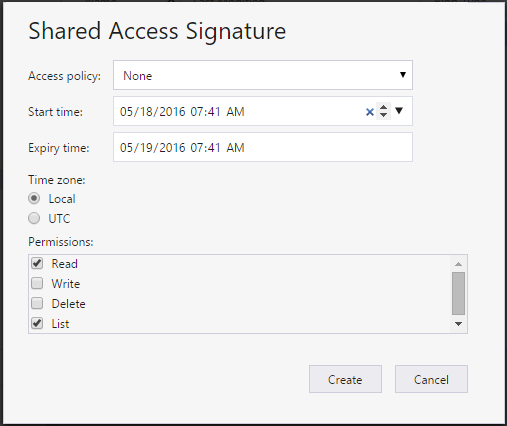
Shared Access Signatures (SAS) can be retrieved through Storage Explorer. Right-click a storage account, container, or blob and choose Get Shared Access Signature... Choose the start and expiry time, and permissions for the SAS URL and select Create. The full URL with the query string as well as the query string by itself are provided and can be copied from the next screen.
Next steps
Azure Blob Storage Explorer
In this quickstart, you learned how to transfer files between a local disk and Azure Blob storage using Azure Storage Explorer. To learn more about working with Blob storage, continue to the Blob storage How-to.